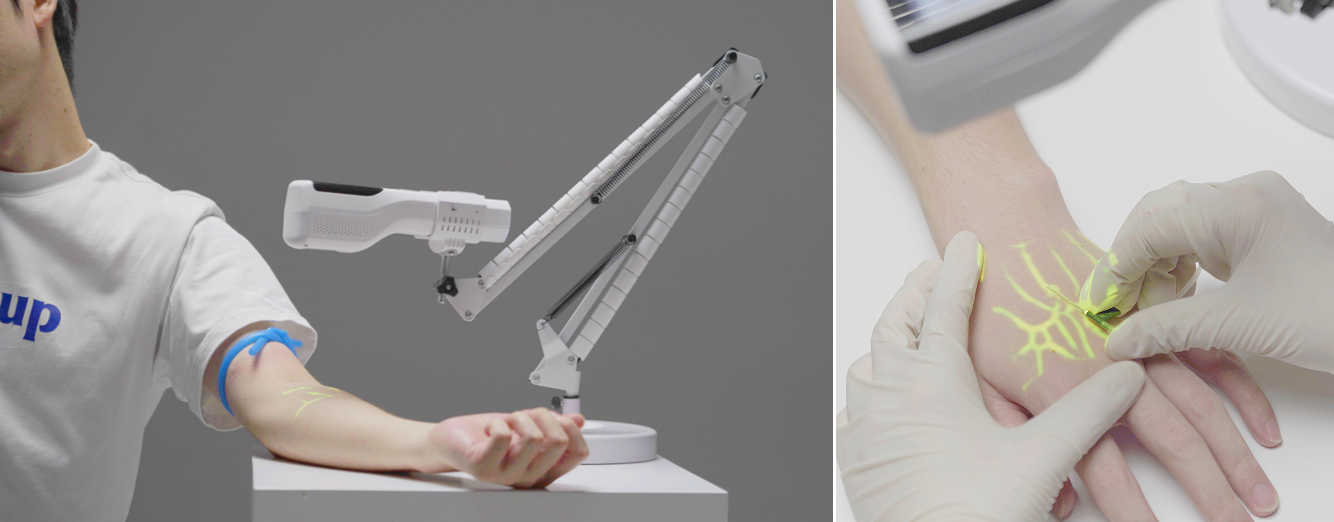
This is Difficult Venous Access , and it is far more common — and far more expensive — than most procurement spreadsheets account for.
The real cost of a missed stick
Most facilities evaluate a vein finder by its unit price. That is the wrong denominator. The right one is the cost of an avoided attempt.
Break the cost of one failed venipuncture into four buckets:
1-Consumables — a second catheter or needle set, skin prep, dressing, gloves, and the sharps disposal that follows. Wasted, not reused.
2-Staff time — every additional attempt consumes several minutes of a skilled clinician. Multiply by the number of difficult sticks per shift, then by 365 days.
3-Clinical complications — phlebitis, infiltration and hematoma extend length of stay and consume nursing time far beyond the procedure itself.
4-Experience cost — the hardest to quantify and the easiest to lose. Patients remember the fourth attempt, not the first. So do their families, and so do online reviews.
How infrared vein visualization actually works
The physics is elegant and decades old. Hemoglobin absorbs near-infrared light more strongly than the surrounding tissue does. A vein finder illuminates the skin with safe near-infrared light, captures the backscatter with a camera, processes the contrast digitally, and projects the resulting vascular map back onto the skin in real time — precisely where the vein actually is.
Three points matter for buyers:
It is non-invasive and non-ionizing. No contact, no radiation, no contrast agent.
It shows perfusion, not a photograph. Veins that are sclerosed, thrombosed or collapsed may not fill, and the device will correctly show nothing. This is information, not failure.
It augments clinical judgment; it does not replace it. The device tells you where a superficial vein is. It does not tell you whether that vein is suitable for the intended therapy, infusion rate or dwell time. That decision stays with the clinician.
Seven things to evaluate before you buy
Not all devices that project veins are equally useful at 3 a.m. in a busy emergency department. Insist on these:
1-Contrast quality across skin tones. Ask to test on the darkest and lightest skin available, not on a healthy volunteer's forearm.
Consistent performance across pigmentation is the single biggest differentiator between a demo unit and a clinical one.
2-Projection accuracy. The projected map must align with the actual vessel. A few millimeters of offset is worse than no device at all, because it creates false confidence. Verify alignment against ultrasound or successful cannulation during evaluation.
3-Adjustable size and depth modes. A pediatric wrist and an edematous adult forearm are different problems. Multiple modes — including pediatric and "deep" settings — determine whether one device can serve the whole facility.
4-Form factor matched to workflow. Handheld for bedside and rounds; table or flexible stand for high-throughput draw stations; mobile trolley for departments that need stability plus mobility. Buying the wrong form factor is the most common reason devices end up in a drawer.
5-Ambient-light performance. Emergency vehicles, operating theatres and sunlit triage areas are bright. Check visibility and projected contrast under real department lighting, not in a dimmed showroom.
6-Infection control compatibility. The device sits in your hand and near the puncture site. Confirm the housing tolerates your approved disinfectant wipes and fits existing cleaning SOPs without degrading.
7-Certification, service and training. Verify CE / NMPA / FDA status for your market, warranty terms, spare parts availability, and whether the supplier provides clinical onboarding. A device without training is an expensive paperweight.
Why good devices still fail: implementation
The most frequent reason a vein finder underperforms has nothing to do with optics. It is deployment.
Use it early, not as a last resort. The largest gain comes from deploying the device during initial vein assessment — before the first attempt — rather than after two failures. Make it part of the assessment step in your SOP.
Pilot, measure, then scale. Run a 2–4 week pilot in the department with the highest difficult-access rate. Record first-stick success before and after. That baseline is your business case for wider rollout, and it is far more persuasive than any brochure.
Assign ownership. Someone must own charging, cleaning and monthly checks. Devices that belong to nobody stop working within a quarter.
Where this fits in a modern access program
Vein visualization is not a competitor to ultrasound-guided cannulation. It sits upstream of it. Where ultrasound is the right answer for deep vessel access and central lines, projection-based infrared imaging is a fast, zero-contact first-line tool for the large majority of superficial peripheral sticks. Used in that order — visualize first, escalate to ultrasound when indicated — facilities typically report shorter procedure times and a measurable lift in first-stick success.
Ready to evaluate?
ZD Medical developed its first vein visualization products in 2012 and has shipped infrared vein finders in handheld, table-stand, flexible-stand and mobile-trolley configurations since. Every unit is built around the same patented near-infrared projection principle described above, and is supported by clinical onboarding for distributors and hospital teams.
Tell us your department mix and monthly puncture volume, and we will help you size the right configuration — and build the ROI case to go with it.
Tel / WhatsApp: +86-187 9586 9515 · Email: sales@zd-med.com


 compatible con la red ipv6
 español
 English
 العربية


